System Architecture
This page provides a high-level view of how DANDI's core components fit together in a typical "full stack" deployment.
The Big Picture
The DANDI platform is essentially composed of:
- Storage: S3 buckets (AWS) where data actually resides.
- API: A Django/Resonant-based backend application (hosted on Heroku) that handles the DANDI data model, user authentication, and orchestrates S3 interactions.
- Frontend: A Vue-based web application (hosted on Netlify) for users to browse, search, and manage data in the archive.
- Workers: Celery workers (also on Heroku) for asynchronous tasks such as file checksum calculations, analytics, and housekeeping.
- Observability: Log aggregation and alerting (Heroku logs), plus Sentry for error-tracking and notifications.
- Infrastructure-As-Code: Terraform scripts that glue everything together—AWS (S3, Route53, etc), Netlify, Heroku, etc.
These services interconnect as follows:
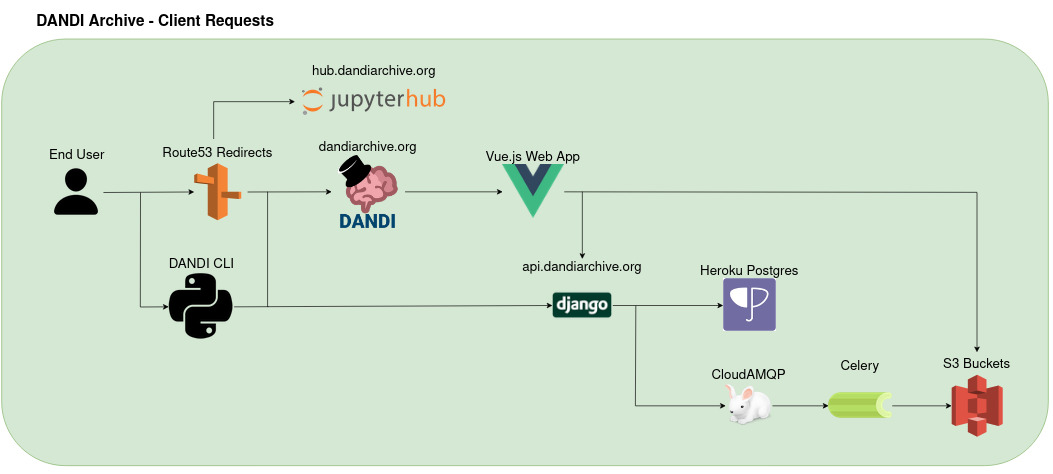
- The user (or script) interacts with the Web UI or the DANDI CLI.
- The Web UI calls into the API (over HTTPS).
- The API queries or updates metadata in its Postgres DB (hosted on Heroku).
- The API calls AWS S3 to read/write DANDI assets.
- Certain heavy-lift or background tasks get queued into Celery tasks, handled by the Workers.
- Domain names, certificates, and load-balancing records are handled by AWS Route 53 or Netlify's DNS, depending on whether it's the API subdomain or the apex domain for the UI.
- Large chunks of data can be streamed from S3 directly to the Client via presigned URLs.
Key Components
1. AWS S3 Storage
- Primary Storage: S3 buckets are the primary storage of the data (Zarr, NWB, etc.).
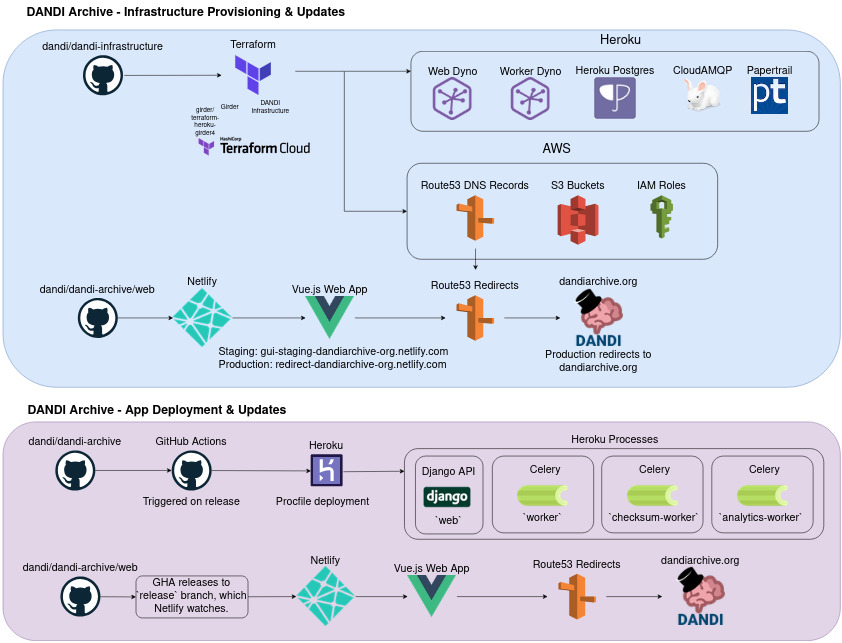
- Configured via terraform: Bucket creation, IAM policies, route to logs, etc., are specified in
terraform/*.tf.
2. Heroku
Provisions the servers, worker processes, and the database for the API.
- API: Django, extended by Resonant, provides REST endpoints for metadata, asset management, versioning, and authentication.
- Postgres: Stores user metadata, dandiset metadata, and references to S3 objects.
- Workers (Celery): Offload long-running tasks (checksums, analytics, zarr validation, etc.).
3. Netlify (UI)
- Frontend server: Serves a static build of the DANDI Archive frontend (Vue.js).
- Autodeployment: On each push or merge to
main(or whichever branch is configured), Netlify automatically builds and deploys. - Configuration:
netlify.toml: Describes build commands, environment variables for sandbox vs. production..env.production: Holds the environment variables for the Vue-based app at runtime (e.g.VITE_API_URL,VITE_SENTRY_DSN).
4. Terraform Infrastructure
The single source of truth for spinning up or tearing down resources such as S3 buckets, IAM users, Route 53 DNS, Heroku pipeline config, Netlify domain config, etc.
- Repo: The
dandi-infrastructurerepo. - Terraform Cloud: Used to plan or apply changes after you push commits to the infrastructure repo.